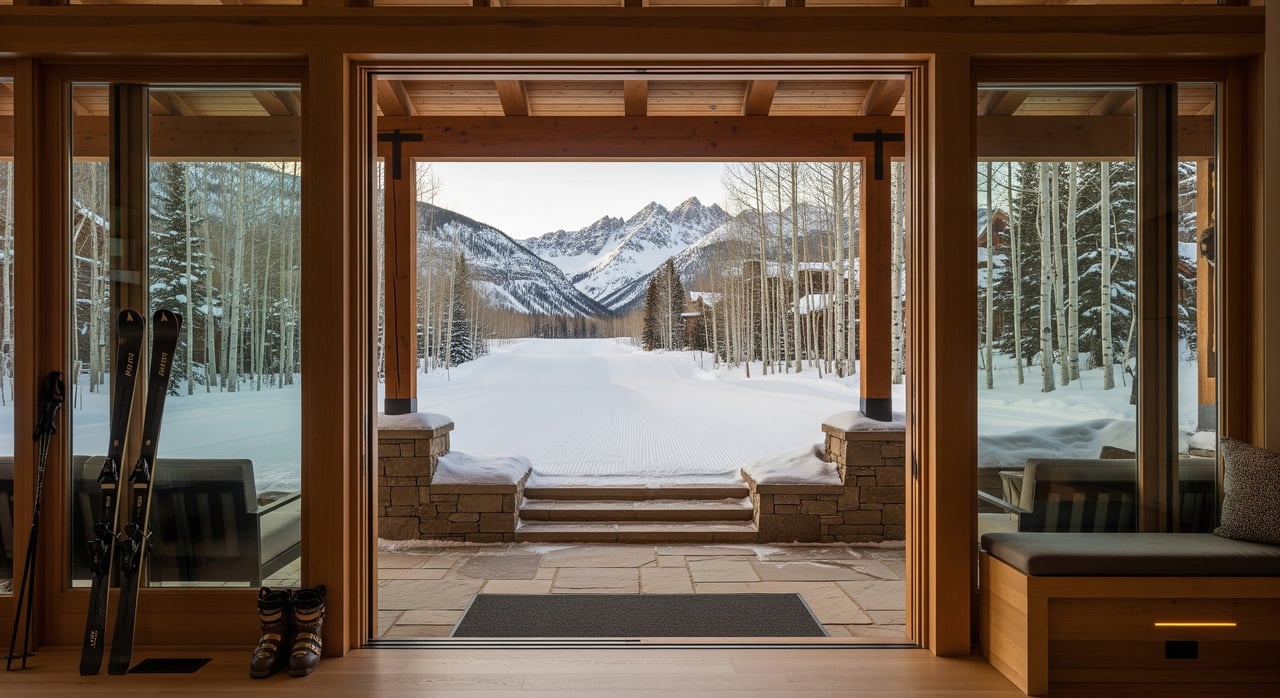
Wondering what really counts as ski-in/ski-out in Mountain Village? You’re not alone. The term is used loosely in many listings, which can make it hard to compare homes or condos with confidence. In this guide, you’ll learn how to define true access, map and verify routes, and understand how these choices affect price, rentals, and daily convenience. Let’s dive in.
Define ski-in/ski-out tiers
Not every “ski-in/ski-out” claim means the same thing. Use these practical tiers when you evaluate Mountain Village properties:
True ski-in/ski-out (Tier A)
- Direct skiable access from your door or building to a groomed run that connects to lifts.
- A reliable, skiable return with minimal carrying of skis and no vehicle or shuttle.
- Usable in typical winter grooming conditions.
Near ski-in/ski-out (Tier B)
- Short, managed walk or flat traverse (often under 200 yards, about 2–5 minutes) to a groomed trail or lift.
- May include cleared sidewalks, stairs, or a brief street crossing maintained in winter.
Not ski-in/ski-out (Tier C)
- Requires a vehicle, shuttle, or gondola for routine ski access.
- Route is interrupted by roads or unmaintained segments that prevent a continuous skiable connection.
When in doubt, label access clearly. For example: “doorstep ski-in/ski-out,” “short-walk ski access,” or “gondola accessible.”
Verify access step by step
Start with the trail map
- Locate Mountain Village base areas, nearby lift terminals, and named runs on the current Telluride Ski Resort winter map.
- Identify which runs are groomed connectors versus steeper, more technical terrain.
Measure the actual route
- Use parcel maps or aerial imagery to find the building and measure the route to the nearest groomed run or lift.
- Trace the real approach, not the straight-line distance. Note stairs, sidewalks, parking lots, or any crossings.
Check grade and maneuverability
- Review the slope near your door. Look for a comfortable grade where you can step in and out of skis safely.
- Avoid long uphill returns, narrow chutes, or steep pitches that complicate daily use.
Confirm grooming and maintenance
- Ask the HOA, property manager, or resort which segments are groomed and how often.
- Clarify who clears snow and ice on sidewalks, stairs, or short crossings.
See it in winter
- Request in-season photos or video of the route, or schedule an on-site winter test.
- Time yourself from door to lift and back, wearing your normal gear.
Local access clues to watch
- Gondola context: The Mountain Village gondola is excellent for getting to town, but it is not a substitute for door-to-piste skiing. If a property relies on the gondola for inbound or outbound access, classify it as “gondola accessible,” not true ski-in/ski-out.
- Lift terminals and run edges: Buildings directly adjacent to lift terminals or groomed run corridors in Mountain Village are more likely to qualify as true access. Verify the exact route and terrain.
- Sidewalks and stairs: Many near-access properties use cleared pathways. These can be convenient, but they still involve a short walk and depend on timely winter maintenance.
- Distance rules of thumb:
- Doorstep: 0–20 feet to snow or a run is typically true access.
- Short walk/traverse: under 200 yards is often near access if the path is maintained.
- Beyond 200 yards, or any route that requires a vehicle or shuttle, is generally not ski-in/ski-out.
Seasonal reliability factors
Mountain Village benefits from high elevation and regular winter snow, but micro-conditions still matter. Review these factors:
Grooming and snowmaking
- Groomed connector runs are far more reliable day to day than ungroomed shortcuts or bootpacks.
- Snowmaking on nearby connectors can improve early and late season access. Ask directly about coverage.
Exposure and aspect
- Higher-elevation and north-facing segments tend to hold snow better.
- South-facing or lower approaches can be thin or icy early and late season.
Common failure modes
- Thin coverage on connectors in early or late season that forces you to carry skis.
- Wind loading and cornices on ridges that change access conditions after storms.
- Grooming priorities that favor main arteries, leaving small connectors delayed after heavy snow.
- Sidewalks or stairways that become slick if not cleared promptly.
Value, rentals, and convenience
Price and rental perception
- Properties with true ski-in/ski-out access often command a premium because of the convenience and broad appeal to skiers.
- Rentals with doorstep access tend to see strong occupancy and nightly rates. Still, interior finishes, layout, and management quality are major drivers.
Operating realities
- Direct-access buildings may include boot rooms, heated storage, and similar amenities that increase HOA fees and maintenance.
- Snow loads and winter services near runs can add to building upkeep. Confirm policies and costs in advance.
- Parking and deliveries may be limited during peak winter. Ask about owner parking and guest arrival logistics.
Daily convenience tradeoffs
- True access saves transition time and makes mid-day breaks simple.
- Near access with a short, maintained walk works for many buyers, especially when sheltered.
- If you must rely on shuttles or the gondola, plan around timing and queues, which can limit spontaneity.
Your comparison checklist
Use this checklist to standardize your evaluation across Mountain Village properties.
Documents and answers to request
- A clear description and map of the route from your door to the nearest lift or run.
- Confirmation of grooming on the connector and typical grooming priority.
- Any recorded easements or rights-of-way that secure the ski connection.
- Details on stairs, steep grades, flat traverses, and estimated elevation change.
- Who clears snow and ice on the connecting path and how quickly after storms.
- Availability of heated gear storage or an indoor ski entry.
- Typical dates or conditions when access becomes limited or closes.
On-site winter test
- Ski out from the unit to a lift and ski back. Count how often you remove skis.
- Time the door-to-lift and lift-to-door routes in full winter gear.
- Note crowding, crossings, and safety at intersections with roads or walkways.
- Capture short videos so you can compare properties side by side later.
Quick comparison fields
- Access tier: A, B, or C.
- Route description: path, surfaces, and any crossings.
- Time to lift: minutes from door.
- Return difficulty: easy, moderate, or difficult.
- Groomed connector: yes or no.
- HOA responsibilities: snow clearing and amenity maintenance.
- Rental notes: demand drivers beyond access, such as finishes and layout.
Ready to compare options?
If you want an expert walkthrough of specific Mountain Village buildings and routes, we can help you classify each property with clarity and confidence. For a private, data-informed consultation, connect with The Agency Telluride.
FAQs
Is gondola access the same as ski-in/ski-out in Mountain Village?
- No. The gondola is valuable for town access, but it does not replace direct, skiable access from your door to a groomed run or lift.
What is a practical distance for near ski access?
- A short, maintained walk or traverse under about 200 yards is often considered near ski-in/ski-out when the path is reliably cleared in winter.
How do I confirm if a connector is groomed?
- Ask the HOA, property manager, or resort about grooming status and typical priority for the exact connector segment serving your property.
Do I need a recorded easement for long-term access?
- Recorded easements or rights-of-way help protect access over time and reduce the risk of route changes or closures.
How does terrain grade affect daily usability?
- Gentle, groomed grades near the property make transitions easy. Steep pitches, narrow chutes, or long flat returns reduce convenience.
Why do true ski-in/ski-out homes cost more?
- Doorstep access is rare and highly desirable for both owners and renters, which often elevates pricing and rental performance compared to non-ski properties.